Tuesday, April 21, 2015

An American Narrative

While researching my junior theme topic, I came across another reason why there exists such a fear of aging in America and why there is such a huge market for things like Botox treatments or "anti-aging" face creams. It all has to do with America's beloved narrative arc. 

Earlier in the year, our class studied Kurt Vonnegut’s piece “A Lesson in Creative Writing” in which he maps out the narrative arc that America loves to see in television and films.
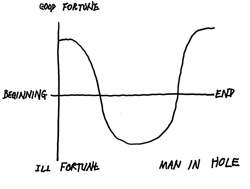


Man in a Hole Narrative Arc


      This arc is also referred to as the “Redemptive Arc,” and it goes back to the roots of Christianity. This is likely a subconscious factor that is playing into peoples’ decisions to get plastic surgery in order to look younger. In the book “You’ve Come a Long Way Baby,” edited by Lilly J. Goren, there is extensive research on what is referred to as “sacrificial atonement.” The book states the “promise” of sacrificial atonement is that "through suffering, death has been overcome” and that these surgeries promise “the illusion that decay can be ‘treated’” (24). This "suffering" is referring to the actual physical pain of a cosmetic surgery, or perhaps the cost. And while the idea of cheating death, or "treating" it, is impossible, it is something that people, especially women, are continuously trying to achieve.
  
This psychological reasoning behind wanting to look younger perfectly follows the narrative drawn above. From "Beginning" to "End" on the graph: A woman starts out healthy and youthful; as the woman ages, she feels her looks are fading; she undergoes a painful procedure to "fix" this problem, and is back where she started, in "Good Fortune", looking and feeling youthful.


We see this archetype in television all the time too: the woman's goal is to look as young as possible. A character that comes to mind is Madame Lalaurie from American Horror Story: Coven, who was obsessed with looking youthful. There weren't face-lifts during the time that she lived, so she resorted to a horrifying method. She murdered her slaves and used their blood as a sort of anti-aging skin product: she would spread it on her face each night. Her extreme and sickening measures she went to in order to feel young "payed off" for her because she felt it made her skin look young again. This character would do anything to maintain her youthful complexion.
      
This is also why America is obsessed with "makeover" shows. There is a "man in a hole"(a person who is not conventionally attractive), and the show helps this person to get out of this "hole," and discover their true beauty. "The internal self is matched with the external" (Goren 25) is something we love seeing on television. Our psychological attachment to this narrative is playing an enormous role in our everyday lives.

Saturday, April 18, 2015

Older Women as Role Models

      While doing some research for my junior theme earlier in the week, I started looking at TED Talks and began taking notes on one I found interesting, entitled Women Should Represent Women in Media.” I found the topic interesting, but realized it did not in fact relate to my junior theme. The TED talk sounded promising at first, since the speaker opens by talking about why she joined the Journalism and Women Symposium: “I wanted female role models.” While the Talk is about women in the media, it focuses on the “incomplete story” we are getting because of the underrepresentation of women as news reporters and sources. This might be too much of a leap to try to work this in to my paper, which is about the underrepresentation of older women in television and films. 

      But when the speaker said the words “female role models,” it made me think of another way this misrepresentation of women in television and films has an effect on our society. Girls and women need older female role models to look up to, and there are almost none. An interview was conducted  by “Mother Jones” magazine with director Jennifer Seibel Newsom (director of the documentary Miss Representation.) Seibel says that “aging is a beautiful thing; wisdom is a beautiful thing. Frankly, as a woman who's getting older in our culture, I want to see stories about women who are before me, so I can be inspired—because someday I'll be there.” The effects of this underrepresentation of older women does impact women of all ages.


      I also began looking at some new books that related to my junior theme topic this week,“The Girl on the Magazine Cover” by Carolyn Kitch explores the stereotypes of women in the media. This book will provide more of the "historical look-back" part of my paper. A passage I found very interesting was about the changing times which seemed to bring about this obsession with youth. On a cover of a 1925 Good Housekeeping, showed a mother reading to her child. The mother was "no longer a Victorian matron, the Jazz age mother was slim and pretty, a youthful woman urged to follow the advice of a 1927 Palmolive Soap ad... that reminded readers to 'Keep That Schoolgirl Complexion' long 'after school days" (145). It will be interesting to delve deeper as to why America is fixated on youth. I also began reading a book this weekend called “You’ve Come a Long Way Baby,” edited by Lilly J. Goren, which is about women in popular culture, which will offer a more current view on the subject. I found that the indexes were very helpful, but when I began reading the book without using the index I also found I was able to read about topics that related to my “why” question, just not as specifically. 

Sunday, April 12, 2015

Age and the Entertainment Industry

For my topic for Junior Theme, I wanted to focus on portrayals of women in television and movies. As I narrowed down my "WHY" question, I decided to look at the reasons why we seem to only be seeing young women in films and television; why is aging in the entertainment industry a positive for men, but a negative for women?

I watched two documentaries that dealt with this topic of portrayals of women in the media. The first was called "Miss Representation," available on Netflix. The documentary interviews several women and men on this topic. A quote stood out to me as I was watching. Gloria Steinem, a feminist organizer and writer and the cofounder of Women's Media Center, said that "a male-dominant system, a patriarchal system, values women as child-bearers, period. So it limits their value to the time that they are sexually active, reproductively active, and become much less valuable after that." I had never really thought about age this way before, and why youthfulness is so valued in our society. It could really be as primal as the fact that there exists a window in which a woman is fertile.

Later in "Miss Representation," PhD Martha Lauzen discussed a striking statistic that 
women in their 20's and 30's make up 71% of women on TV. 
"What we see on broadcast television is that the majority of female characters are in their 20's and 30's. That is just a huge misrepresentation of reality, and that really skews our perceptions." It is saying something interesting about our society that women who are over 40 actually account for 47% of our population in the U.S, but are only making up 26% of women on television. Why are only young women given the spotlight?

I watched a second documentary titled "Killing Us Softly 4," available on YouTube. It made me think about cosmetic surgery being an aspect of an answer to my "WHY" question. I learned that 91% of cosmetic procedures are performed on women, and from 1997 to 2007, there was a 754% increase in non-surgical procedures like botox and laser treatment. Botox makes the face look tighter, and more youthful. What sparked this intense need for women to look younger? Jean Kilbourne, the writer of "Killing Us Softly" explores this when she says that "This contempt for women who do not measure up is waiting for all of us of course eventually as we age, so no wonder there's such a terror of showing any signs of aging." Women in America seem desperate to turn back the clock and look like a younger version of themselves, why is this?


Sunday, April 5, 2015

The "Blurred Lines" Copyright Issue

       A couple of weeks ago in class, we discussed the “Blurred Lines” copyright issue. We listened to clips of the songs “Blurred Lines” by Robin Thicke and Pharrel Williams and “Got to Give It Up” by Marvin Gaye side by side to determine if we thought the songs were a bit too similar and if it really was an issue of plagiary. The jury who was deciding the verdict; however, was supposed to make this decision based only upon sheet music of both songs. But with only a number of chords out there to work with, the line between whether or not a song is "plagiarizing" or not becomes very thin. 

       The whole discussion in class reminded me of a video I had seen a couple of years ago. A comedy rock band “Axis of Awesome” performed a funny skit in which they demonstrate how so many of our beloved pop songs are, in fact, just made up of the same four chords. It's pretty eye-opening. Here’s the video: 


       I was amazed when I first watched the skit. All of these songs can be played using only four chords, but are all widely accepted as totally different songs. But isn't it the artist's spin on these same four chords really what makes each song unique? The court ruling seemed to suggest otherwise, since Pharrell Williams and Robin Thicke now owe 7.3 million dollars to the Gaye estate on the grounds of copyright infringement. The reason I take issue with the verdict is that there seems to be no clear line between taking inspiration from an artist and actually copying an entire song. “Got to Give It Up” and “Blurred Lines” may sound similar, but so does every pop song!

Sunday, March 22, 2015

Meghan Trainor’s Contradictory Messages


Meghan Trainor’s recent single “Dear Future Husband” has sparked a minor outbreak across the internet; people are ranting about the fact that the song (and the song’s music video) are deeply sexist. The song has a few lines that made me raise my eyebrows, but there was also some pro-feminist language in there. To give an example of the former, here is a short clip of Trainor in her new music video:


In case you couldn't catch the lyrics, she is singing "cause if you treat me right, I’ll be the perfect wife, buyin’ groceries, buy, buy what you need” while cleaning the kitchen floor. Trainor is essentially giving us a definition of the “perfect wife,” and in 6 seconds has managed to reduce women down to the person who does the shopping and the cleaning in the house. Her definition of a perfect wife seems to be all about pleasing her husband. The music video seems to be reminiscent of the 1950’s, with the costumes and the set, but the actual lyrics sound about as sexist as many people were in those days. The story her song is laying out is heteronormative and only reinforces gender roles. However, the line directly after this one was one that was pretty clearly trying to break gender stereotypes…


Trainor uses the phrase “9 to 5” and claims that both she and her husband will be in the workforce, and that he shouldn’t expect her to be cooking for him. This showed more empowerment of women, that the perfect wife is not defined by whether or not she’s at home baking pies all day. But then why did she just give us this basically opposite idea 1 second before, with her very retro definition of what it means to be the perfect wife?

This isn't the first time it's been unclear to me whether Trainor is trying to promote feminism or not. In her song "All About That Bass," she offered even more contradictory lines, saying "don't worry about your size" and "every inch of you is perfect from the bottom to the top" but then proceeds to talk about "skinny bitches." So is the song really about accepting yourself and loving your body? Or is she really just putting down all body types in her attempt to celebrate one? If Trainor is aiming to empower women, she might need to take a better look at her lyric choices.

Saturday, March 14, 2015

The Shocking SAE Chant

While watching a Daily Show clip regarding the recent SAE University of Oklahoma fraternity chant scandal, I was in awe when I saw some of the media's reactions. A video was recently leaked of a chant that SAE fraternity members at University of Oklahoma were singing. The chant describes their rush policy, and goes, "You can hang them from a tree, but they will never sign with me. There will never be a n***** SAE."

The chant was so shocking to me; it brings into question just how far we really have come from the racism that existed about 100 years ago. The chanters refer to the atrocious, primitive times of racial terror lynchings that went on, saying you "can hang them from a tree." I found this word "can" to be a particularly unpleasant. The chant is implying that you (as a white male SAE member) are not only capable, but are being permitted to hang a black person. This chant is unbelievably backwards.

While some media coverage has called the video "racist" and "disgusting," there are a lot of commenters who think otherwise. USA Today broadcasters blamed the situation on "hip-hop," since the listeners hear this word over and over, will obviously start repeating it. Not true. This is one of the most naive and ignorant conclusions to draw, that racism today is a product of the music we listen to... Here's a clip of John Stewart's reaction to this.


There is just no excuse for the racism that is going on here. When the leader of the chant finally apologized for the incident, he said that "alcohol" had something to do with his decision-making that night, which I still feel is an entirely unreasonable excuse. The chant wasn't made up on the spot. So whether or not alcohol was hindering the chanter's judgement, these racist words existed before the incident, but this was the first time it was brought to the public's attention.

This whole situation is also relating to what we've been talking about regarding who is "allowed" to say the "N" word, and I think it was certainly inappropriate in this case because not only are the chanters saying this word, but the actual intent and message they're getting across is that they will never allow black people to join SAE, and that they condone the atrocities that occurred during the racial terror lynchings. And the media making excuses for this indisputable racism is only furthering the problem. This is the kind of backwards thinking that is pushing America in the opposite direction it needs to be going.

Thursday, February 19, 2015

Disney Princess's Impossible Proportions

While scrolling through Buzzfeed, I found a picture that made stop and take a second glance. The article was entitled "Pop Princesses Photoshopped To Have Disney Princess Proportions." This is what singer Taylor Swift would look like if she had the same body proportions as a Disney animated princess.


As you can see, a real-life person looks laughable with these proportions. Her waist is basically the same size as her neck and her eyes look about the size of tennis balls. After I got over how ridiculous she looked, I started to think about the implication this has. These animated princesses are drawn so unrealistically and it's sending the wrong message. I thought Barbie proportions were bad, but these princesses are on a whole different level.

What young, impressionable kids are seeing on screen really does impact them later on. It has an influence on beauty stereotypes they'll grow up thinking, because their favorite Disney princess has an impossibly thin waist, toothpick legs and arms, and gigantic eyes. Parents are feeding their children these beauty standards without even realizing it.

And we don't really see the same thing with men. The Guardian had an interesting article about this topic regarding male love interests in Disney animated films, saying they "may have puffed-up chests and broad shoulders, but their proportions are at least feasible. Half the male Olympic swimmers could pass for Disney princes." It might be a little more understandable if characters were all being drawn so exaggerated, but it's only the women! It seems like men's bodies are being exaggerated with the large muscles and broader shoulders, while women characters are exaggerated by being made extra meager and small.

Why are these princesses being drawn like this? Is Disney afraid if they put a princess on screen who has a normal woman's body proportions that the kids won't enjoy the movie? It seems like a terribly easy fix. Disney has the power to influence kids, and they could use this power in a really good way (like drawing princesses who have a healthy person's waistline), but they're using it to do the opposite. They're enforcing these impossible beauty standards when it seems so easy to just draw a princess with a waist a few inches thicker.